
What is a Dog For?
Why “good behavior” and “a good life” aren’t always the same thing

Several years ago, I was telling a family member about my experience meeting a popular dog trainer and her dogs. The first question I got back was, “Are her dogs perfectly well-behaved?”
That question has stuck with me for years.
Do we need our leaders to be “perfect” in order to follow them? Is imperfection a sign of failure in the dog training world? And maybe more quietly… is that the underlying fear? That if our dogs aren’t “perfect,” then we’ve somehow failed them?
When I was growing up, I had an Australian Shepherd named Maggie. We didn’t know it at the time, but we got her from a less-than-reputable breeder. She was my best friend, and she struggled with the world. She was anxious, solemn, and serious.
At the same time, my family had golden retrievers, and the contrast was stark.
One of my relatives came away from that experience believing all Australian Shepherds were like Maggie—serious, intense, type A perfectionists.
Years later, I brought home Max.
I watched that same relative try to make sense of him.
“What’s wrong with Max? He’s bouncing off the walls—like an ADHD kid with too much sugar trying to do parkour.”
Nothing is wrong with Max.
He’s happy.
Yes, he’s a lot. Some might even say he’s too much. But it’s his muchness that brings me joy. He feels everything out loud, and then he sleeps—deeply—once he’s done.
He doesn’t perform calm for anyone else’s comfort.
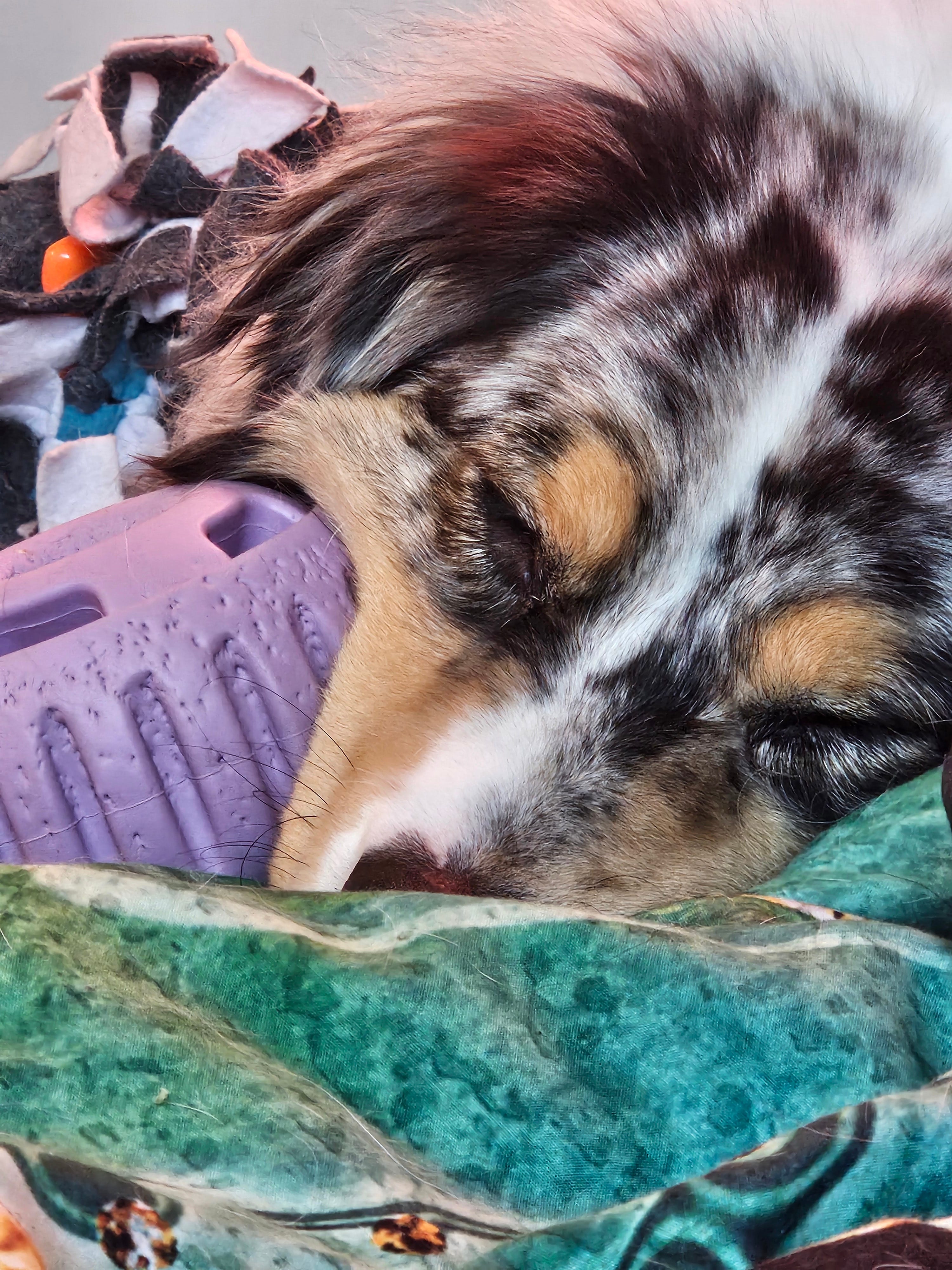
In his world, his experience is just as valid as anyone else’s. And I love him for that.
My job, as the responsible adult in the room, isn’t to make him smaller. It’s to help him be himself as safely as possible.
His bouncy joy and snoring naps are my markers of success.
Dog training sits at a strange intersection—ethical welfare, scientific understanding of learning and consciousness, relationship-building, and personal identity. It’s also a largely unregulated field, which means anyone can call themselves a dog trainer. And when people build their identity around a particular method or philosophy, questioning that approach can feel like questioning them.
I feel that too. I have to actively remind myself of it so it doesn’t quietly shape how I show up in these conversations.
But underneath all of this, I think there’s a deeper disconnect.
Maybe the problem isn’t that we disagree on methods.
Maybe it’s that we’re not even measuring the same thing.
To some people, a good dog trainer creates good behavior.
To others, a good dog trainer understands the dog behind the behavior.
Those two definitions might sound similar, but they lead to very different outcomes.
A dog can look perfect and still be overwhelmed, shut down, or unresolved.
A dog can look messy and actually be thinking, processing, and recovering.
If we don’t define what we’re actually trying to create, then every conversation about training gets stuck in the same loop—debating techniques without ever agreeing on the goal.
Because one person is asking, “Is the dog behaving?”
And another is asking, “Is the dog okay?”
I’m curious—what do you find yourself measuring most often?
“ to help him be himself as safely as possible.”
This resonated so hard with me! In my dryland mushing group, so many people showed up kind of embarrassed with their “bad” dog - me included! And all these dogs just needed a safe way to dog joyfully. I’m so excited to see more and more people working WITH the dog instead of putting behaviors on auto.
Yes to all of this. I work with dogs, helping with behaviors that are concerning and even scary to their humans, as well as teaching dogs fun sports activities. When the general public learns this is what I do, invariably someone says “oh boy, I bet your dogs are perfectly behaved.” And it just makes my skin crawl and simultaneously bums me out. Your words explain this perfectly — thanks!